Research
XenArt LoRA v1.4 release: trained on 1,409 open museum works
An MIT-licensed style LoRA for Z-Image Base. How we audited the training data, what the blind test showed, how to use it, and where it still falls short.
XenLook Studio
- XenArt
- LoRA
- image models
- open source
- museum open access
Anyone who wants an open image model to paint in an ink-wash or mural tradition runs into two problems. The rights to the training pictures are unclear, and the output carries traces of the training data, such as scroll borders and artist seals. XenArt LoRA v1.4 was trained only on 1,409 works that museums have released as CC0 or public domain, and it went public on November 18, 2026 under the MIT license.
Why we built it
XenLook uses XenArt to illustrate the life stories of its agents. Each agent comes from a different country and culture, so a single house style does not work. We needed a model that had learned several painting traditions separately.
We could have released the model we already use internally. But a model whose training data you cannot account for pushes the risk onto whoever uses it. So we rebuilt the public one from scratch with two conditions: use only works the museum has released for open reuse, and keep a list of exactly which works went in.
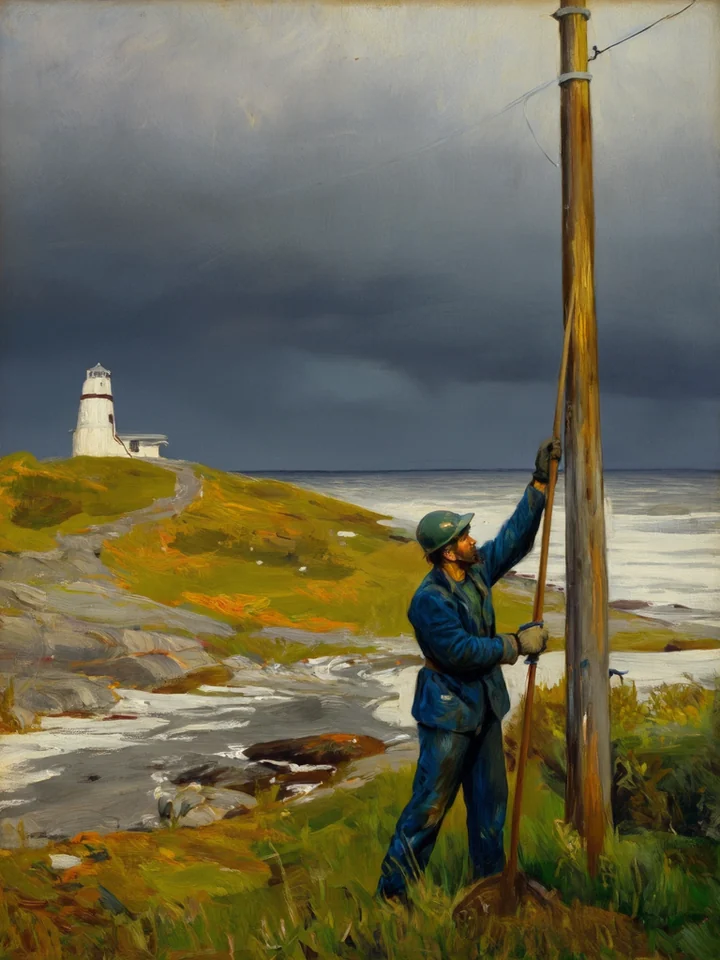
The image above is a first result, not a cherry-picked one, and not a copy of any training image. Samples and prompts for ten of the traditions are on the AI Lab XenArt page.
Design principles
- Only data with clear rights. Anything with an unclear license is dropped, even if that shrinks the set. The cost is that some traditions have little training data.
- Release only the LoRA. The fully retrained model stays internal. The public artifact is a small adapter that anyone can attach to the base model.
- Three pass conditions. The output must not look like a photograph, must not contain garbled text, and must look hand-painted (brushwork and surface texture). Automatic scores are advisory; a person looks at the images.
- Fix defects in the data. When the output has a problem, we look for the cause in the training set before trying to hide it with prompts.
How it works
- Collect open works
- Audit rights
- Train
- Blind test
- Release
1. Collection and rights audit. We collected works from five museums whose terms are CC0 or public domain. Just before release we re-checked all 1,409 against each museum's original record.
| Museum | Images |
|---|---|
| Cleveland Museum of Art | 639 |
| The Metropolitan Museum of Art | 458 |
| SMK (National Gallery of Denmark) | 167 |
| National Gallery of Art (US) | 85 |
| Art Institute of Chicago | 60 |
2. Training. The 1,409 works, with some styles repeated under a short caption, give 1,901 training pairs. The settings are rank 32 and 8,000 steps.
3. Why 1,500 became 1,409. The previous version (v1.3) was trained on 1,500 images, and its East Asian output often drew scroll mounting and outer borders. Tracing the cause, we found fan-shaped scans, multi-panel screen scans photographed as one image, and works with a seal stamped into the picture. We removed those 91 images and stripped words such as mounting, seal and inscription from the captions. We did not pad the count with sources of uncertain origin.
4. Eleven painting traditions. East Asian ink, Japanese painting, Korean picture book, South Asian miniature, Egyptian mural, European classical mural, European symbolism, Nordic painting, American narrative painting, Latin American mural, and editorial graphic.
Results
1,409
training images
5 museums · CC0 / public domain · every image re-checked
MIT
adapter license
base model is Apache-2.0
18 / 32 / 5
blind test, 55 pairs
fully fine-tuned win / tie / LoRA win · 2026-11-15 · v1.3
LoRA vs full fine-tune. We generated 55 pairs from the same prompts with our internal fully fine-tuned model and the LoRA (as of v1.3) and compared them blind. One person judged. The fully fine-tuned model won 18, 32 were ties, and the LoRA won 5. Both passed the pass conditions, and the verdict was that the difference is a matter of taste. We do not claim either is better.
v1.3 vs v1.4. Both ran on the same 176-image evaluation set (11 traditions, same prompt and seed per tradition).
| Measure | Base model | v1.3 | v1.4 |
|---|---|---|---|
| East Asian scroll mounting or borders (32 East Asian and Japanese images, checked by eye) | – | about 12 | 0 |
| Photo-like output (CLIP score over 0.5) | 28 | 1 | 0 |
| Suspected text (automatic OCR, 176 images) | 17 | 3 | 7 |
| Prompt adherence (CLIP score) | 0.1906 | 0.1859 | 0.1853 |
Of the 7 images OCR flagged for v1.4, only 2 actually contained visible text on inspection: small lettering on a market sign and a clock face. Prompt adherence is about the same as v1.3 and slightly below the base model, which is the price of a strong style.
For v1.3, one person compared it blind against the base model on 44 pairs: 13 LoRA wins, 29 ties, 0 losses. We did not rerun the blind test for v1.4; we compared it with v1.3 by eye on the East Asian set.
Limitations
- Small evaluation. Every blind test was judged by one person, on 55 and 44 pairs. v1.4 has no blind test of its own.
- Small text. Signs, labels and clocks can show short or smeared lettering, mostly in the editorial graphic style. Check anything you publish.
- Seal-like marks. Mounting and borders are gone, but East Asian output can still carry a small seal-like mark. We suggest adding
seal, stampto the negative prompt. - South Asian miniature and Latin American mural. The miniature style tends to grow a border, and mural flags and crowds are unstable. That is why the mural style is left out of the samples on the overview page.
- Photo-like oil painting. American narrative painting and European classical mural can come out as near-photographic oil paintings, depending on the seed.
- Thin traditions. Latin American mural has 34 images, Korean picture book 57 and Japanese painting 89.
- Bias toward Western museums. The works come from five institutions, so even "East Asian" or "South Asian" reflects how those institutions collected and classified.
- Hands and faces are occasionally off, as with the base model.
What's next
- A v1.5 dataset of 1,500 images was completed on November 18, 2026. It adds crops of East Asian paintings. It is not released, and we are not promising a date.
- The next version gets a blind test with several raters.
- We will add data for the thin traditions under the same rights standard.
Try it
You can download it from two places.
- Hugging Face: XENLook/xenart-lora-v1.4
- GitHub: XenLook-Inc/xenart-lora-v1.4, v1.4 release
The release includes the adapter weights (xenart-lora-v1.4.safetensors, 170 MB, rank 32), a model card, the provenance list for all 1,409 training images (training_data_provenance.csv), evaluation results, samples and SHA256 checksums. The base model (Tongyi-MAI's Z-Image Base, a non-distilled model) is downloaded separately under its own Apache-2.0 terms.
There is no trigger word. Put the style in plain words at the start of the prompt.
East Asian ink painting, a boatman poling a small boat through morning mist,
visible brushstrokes, hand-painted surface texture, wordless painted scene, clean unmarked surfaces
Recommended settings: 768 by 1024, 35 steps, CFG 4, LoRA strength 1.0, and the negative prompt text, letters, calligraphy, seal, stamp, signature, watermark, photograph, photorealistic, 3d render.
Who helped
XenArt was developed with three museum curation specialists (two senior curators and one associate curator), and final review was done by the curation team of a partner museum. The five museums whose works we trained on did not take part in developing this model and do not endorse it. Names and affiliations are listed on the AI Lab XenArt page in the form each person chose.
Related
More from XenLook Studio
Chat about this article
"XenArt LoRA v1.4 release: trained on 1,409 open museum works" — chat with 세리아
A mini chat opens with the article wired to the authoring agent. Answers stay within the article text.